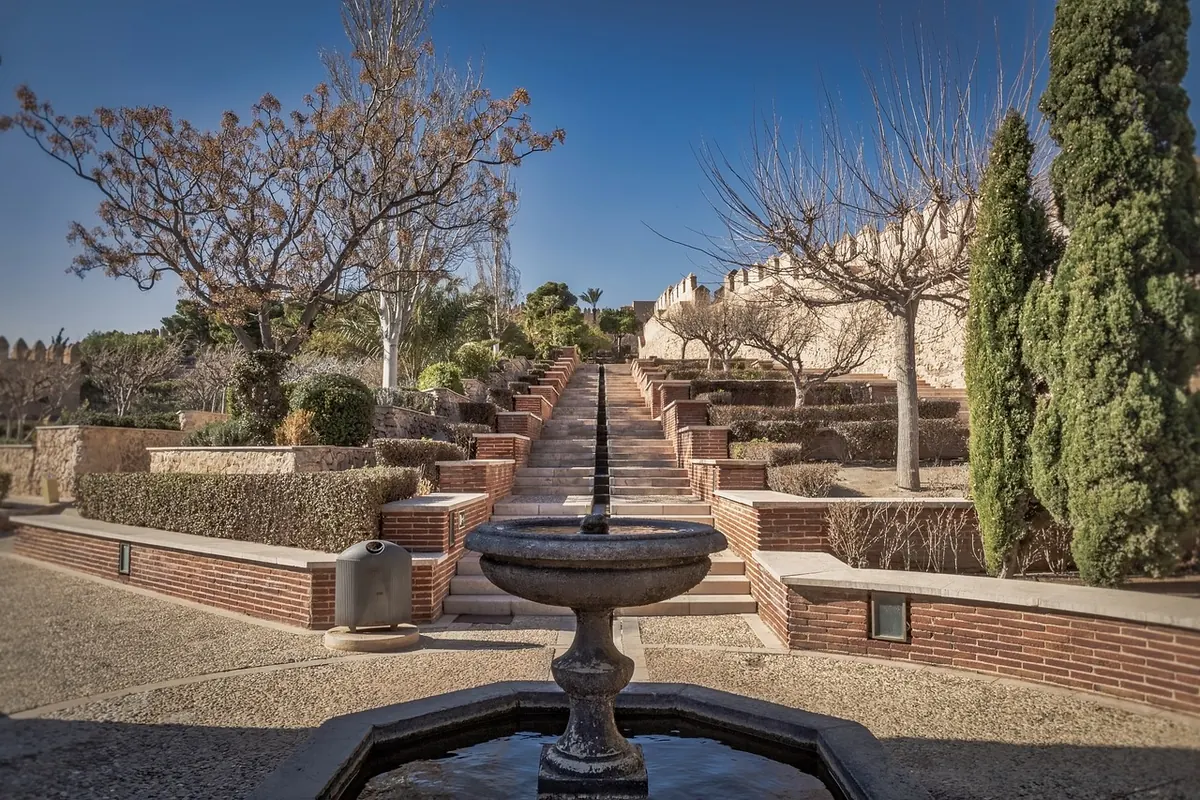
A courtyard garden is a demanding client. It has walls on three sides, a drain in one corner, light that arrives late and leaves early, and a view that matters from every window in the flat. You want something vertical, evergreen and unmistakably Mediterranean. Cypress answers all of that, which is exactly why so many small city gardens end up with the wrong one.
The trouble is the word itself. "Cypress" is a shop label, not a species. It covers a dozen quite different trees with different roots, different water needs and wildly different eventual heights. Choosing well comes down to three questions you can answer before you ever look at a price tag: how big does it really get, what does it do underground, and what will this particular courtyard do to it?
Most plants sold as cypress fall into two groups, plus one outlier that needs its own warning.
True cypresses (Cupressus) are the Mediterranean and desert species: the Italian cypress that lines Tuscan roads, and the tougher, blue-grey Arizona cypress. They want sun, sharp drainage and plenty of air. Give them those and they are close to unkillable. Give them a damp, shaded corner and they sulk, brown off and eventually die.
False cypresses (Chamaecyparis) include Lawson cypress, Hinoki cypress and Sawara cypress. They are the ones with the enormous range of compact cultivars, and many of them are genuinely happy in a bed two metres wide. They generally prefer a soil that holds some moisture and will take light shade, which makes them the better bet for a north-facing yard.
Then there is bald cypress (Taxodium), which is deciduous, wants wet ground and grows into a large tree. Beautiful in a park. Not a courtyard plant.
A nursery pot is a poor guide to the future. A one-metre Italian cypress in a three-litre pot can still become a fifteen-metre column. The number that matters on the label is the ultimate height and spread, not the current one.
Classic Italian cypress is columnar but not small: roughly one to three metres wide and, in good conditions, well over ten metres tall. In a courtyard that is a spire you will be looking at from below for the rest of your life, and it will eventually shade the whole space in winter. Some gardens can carry that. Most inner-city courtyards cannot.
Fortunately, the same species offers compact selections. Dwarf and slow-growing Italian cypress cultivars, often sold under names such as 'Totem' or 'Tiny Tower', keep the tight vertical silhouette at a fraction of the size. Among the false cypresses, forms like 'Ellwoodii', 'Columnaris' or the soft blue-grey 'Boulevard' stay in the two-to-four-metre range for years, and Hinoki cypress cultivars will sit happily in a large pot for a decade.
Read the tag twice. If it says "slow growing" but also "ultimate height 12 m", believe the second figure. Slow just means you get longer to regret it.
Cypress roots have a better reputation than most large conifers, and it is largely deserved. True cypresses in open ground tend to root deeply and anchor firmly; they are not in the same league as poplar or willow for hunting drains. False cypresses make dense, fine root plates that are more shallow but far less aggressive than the notorious Leyland cypress, whose fast, spreading roots are a common source of neighbour disputes.
That said, roots do what the site allows. A courtyard built on rubble, compacted subsoil or a thin layer of topsoil over hardcore gives a tree no choice but to spread sideways, just under the surface. Two things follow from that:
If the courtyard sits against a retaining wall, a cellar, a bay window or an extension on clay, get an arboricultural or structural opinion before planting anything with a future above four metres. That is a conversation worth having once, early, rather than after the paving lifts.
Italian and Arizona cypress want full sun, meaning most of the day. In a courtyard that only sees direct light for three hours in midsummer, choose Chamaecyparis instead, or accept a thinner, leggier tree.
Winter waterlogging kills more cypresses in cities than cold ever does. Plant on a slight mound, improve the soil with grit and organic matter, and never put one at the bottom of a slope or beside a downpipe. If the hole fills with water in February and stays full, plant something else or use a raised bed.
Walls store heat and bounce it back, so soil against a south-facing facade dries fast and hard. That suits Arizona cypress and established Italian cypress; it does not suit young Hinoki cypress. Courtyards also funnel wind, so stake a new columnar tree for its first two seasons and then remove the ties, before the trunk grows around them.
Cypress canker shows up as sunken, dead patches of bark with dieback above them. There is no reliable cure once it takes hold; remove the tree, and do not replant the same species in the same spot. Good air movement and avoiding injuries to the trunk are your best defences. Root rot, by contrast, is a drainage problem wearing a disease costume.
One more consideration that rarely appears on the label: cypress pollen is a significant spring allergen in Mediterranean climates, and a courtyard puts you directly underneath it. If you plan to eat lunch under the tree in March, that is worth knowing.
And check the rules before you dig. Many cities protect trees above a certain size, restrict hedge heights or require permission for work near a boundary. If you rent, ask the landlord in writing.
Get those six answers straight and the choice becomes almost obvious. A courtyard cypress should feel like a deliberate piece of architecture, not a mistake you are pruning twice a year to contain.
Photo: ddzphoto / Pixabay

A practical troubleshooting guide to the most common urban tree watering errors during heat waves — frequency,...
Columnar cypress can screen a narrow driveway without turning it into a tunnel. Here is how to choose, lay out, and...
Mulch is the cheapest help a street tree gets—and one of the easiest ways to harm it. Here's how deep, where to...

Italian city trees and green spaces.
